Rustar
Home
Community
Game
Albums
Back
Blacknetbar
Oct.30,2023
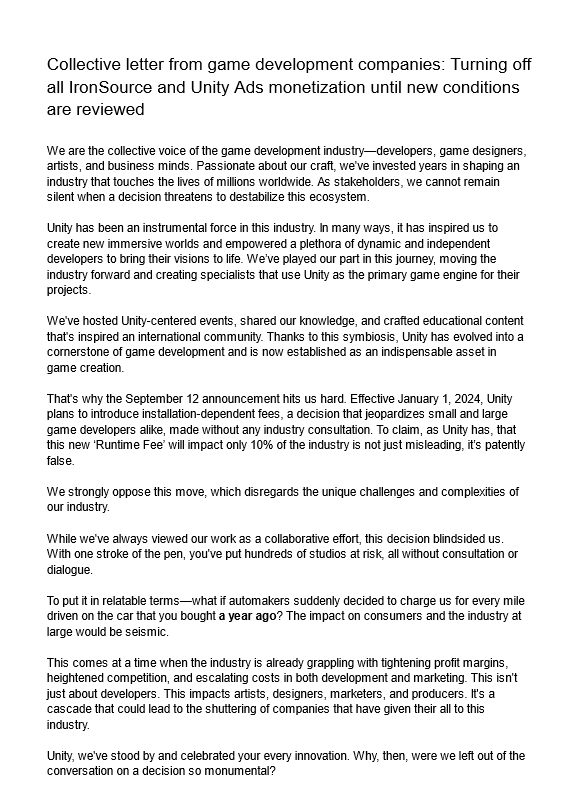
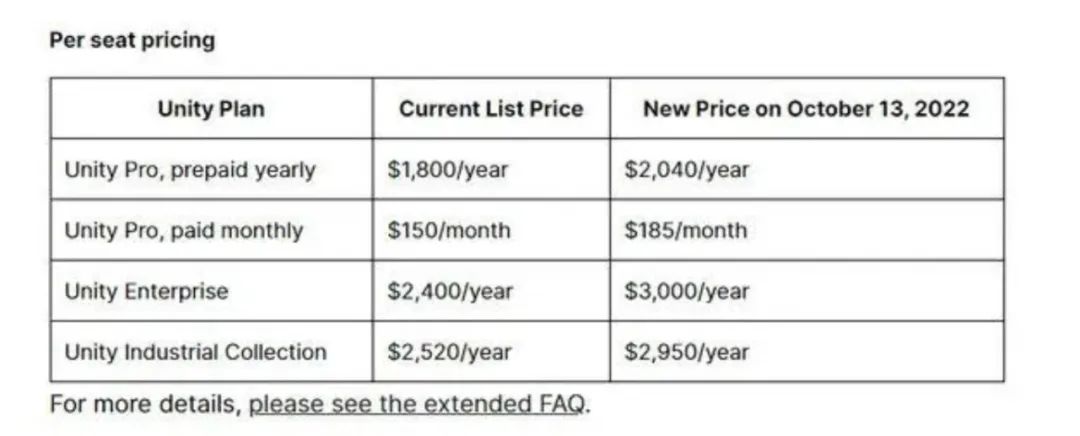
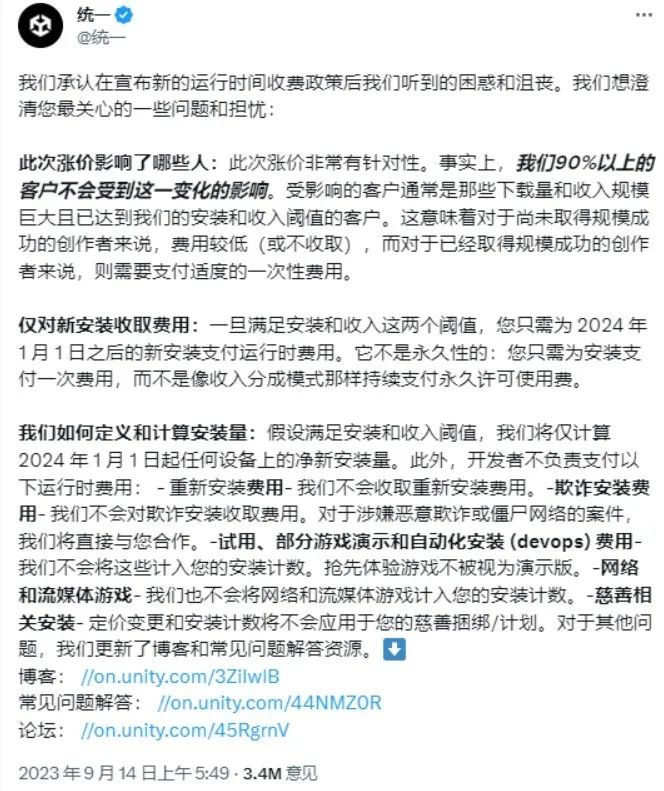
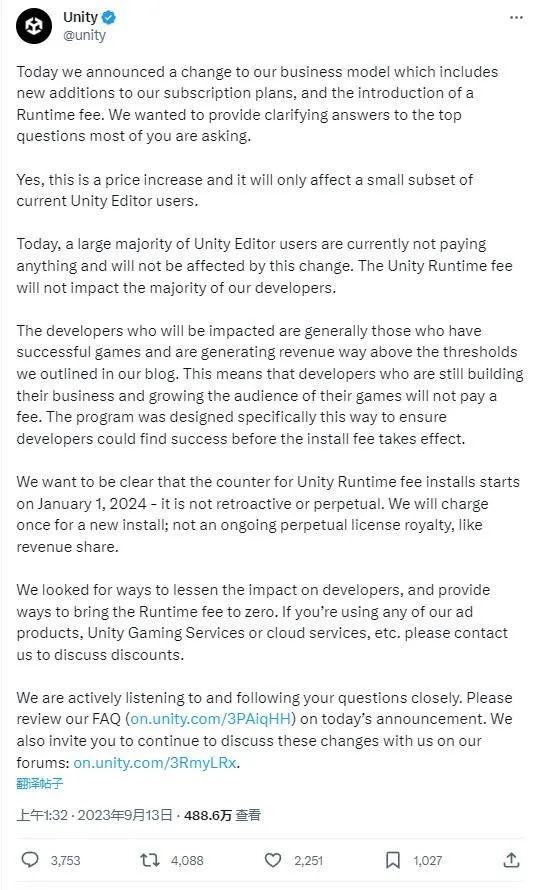
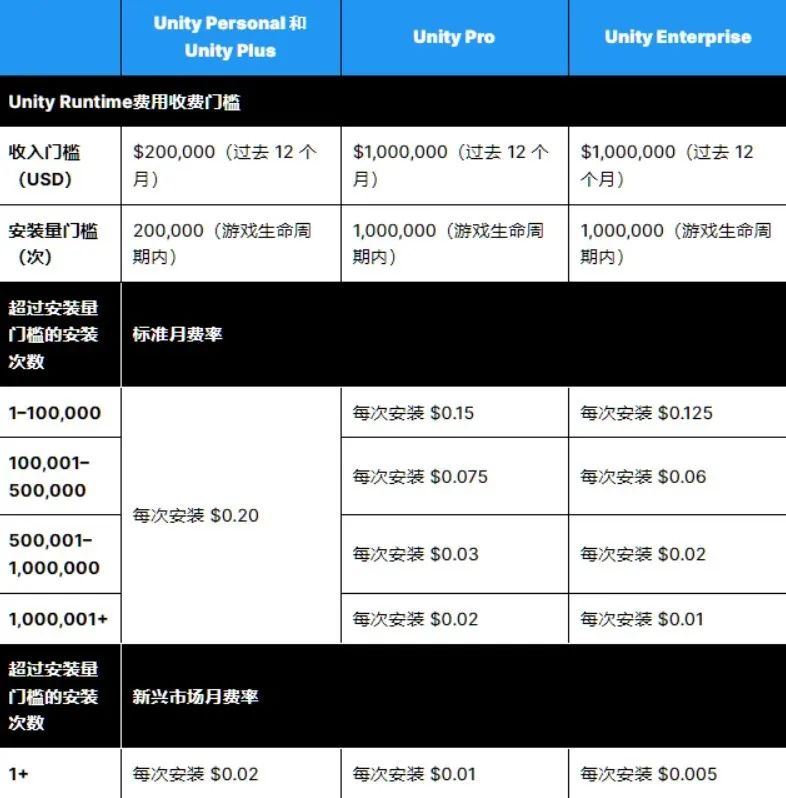
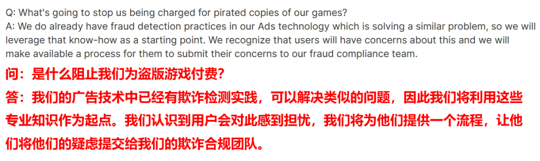
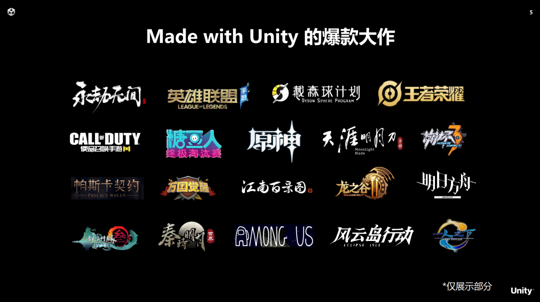
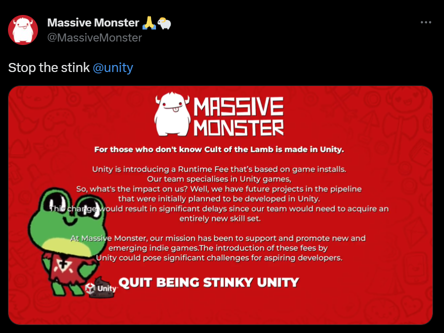
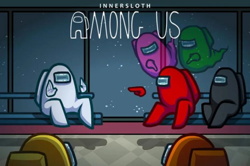
Officially announced, Unity charging fees, being criticized by various game developers! I'm sure all of you are no strangers to "Unity." As the most popular game engine on the market today, Unity has garnered the favor of many game developers and companies due to its "visual programming interface," "easy entry," and "cross-platform capabilities." Currently, nearly half of the games on the market are developed using the "Unity" engine. It stands shoulder to shoulder with "Unreal" as one of the dominant forces in the game engine industry. It's safe to say that anyone who's a gamer has had some interaction with the "Unity" engine. "Unity," born in 2005, has now been around for 18 years. In these decades, "Unity" has helped numerous game developers realize their "gaming dreams" and has built a good reputation and prestige over its long-term development. However, as the saying goes, "It's easy to climb up, but hard to come down." Unity, which has been painstakingly cultivated for nearly 20 years, saw its reputation crumble overnight due to a new policy announcement. Just a few days ago, Unity announced that starting from January 1, 2024, it will charge all users an "installation fee." This sudden announcement left all developers using Unity dumbfounded. The new policy stipulates that games will be billed based on the "number of installations." Once the number exceeds 200,000, the player will have to pay a "installation fee" of $0.2to Unity for each game installation. Corresponding "bulk discount" policies have been introduced for large game development companies. Billing will start only when a developer's annual income reaches $1 million, and the number of installations exceeds 1 million. The "installation fee" will gradually increase from $0.01. Due to the vast number of Unity users, the official announcement of the new charging rules caused an uproar in the gaming industry. Before this, Unity's subscription for individual developers was entirely free. Only the "Professional" and more advanced "Enterprise" versions aimed at groups and companies incurred charges. Now, as long as the download count exceeds the 200,000 threshold, developers must pay an additional $0.2 installation fee, which is undoubtedly a disaster for small and medium-sized game developers. From the perspective of the charging standard, the impact on independent game developers is not that significant. The number of games that can surpass 200,000 downloads in a year is limited, and reaching this level naturally means there is no need to worry about revenue. Moreover, large companies have discount policies to cover them, and they can also privately negotiate some kind of "agreement" with Unity. In essence, they might end up earning even more than before. What is significantly impacted are "free games that rely on in-game purchases to sustain revenue," just like games such as "Among Us," which have sky-high download counts but meager actual revenue. If they are billed according to the number of installations, these games could immediately go into a financial deficit. Leaving aside whether Unity's new rules are reasonable, just counting installations poses a significant problem, especially in the context of "distinguishing pirated copies." Previously, there had always been jokes circulating that "repeatedly installing pirated games could bankrupt a company." Unity's new rule of billing based on "installation count" might indeed lead to game companies being bankrupted by repeated game installations. However, Unity seems to have absolute confidence in identifying pirated games. In a subsequent Q&A announcement, they stated, "We have patented-level technology to detect whether games installed by users are pirated. Please rest assured, developers." The rampant extent of pirated software continues to this day, and it's challenging to entirely prevent it. This undoubtedly makes people curious about the "black technology" that Unity uses to accurately detect pirated games. On the other hand, in the Q&A announcement, the official stated, "Games that are repeatedly installed, installed on different devices, do not differentiate between demo and full content, and those on subscription platforms will all follow the 'installation fee' rule." This "robber-like" billing method naturally led to the scene of "numerous developers pointing fingers at Unity" as mentioned earlier. Seeing that developers overwhelmingly reject the new charging method, Unity quickly clarified the charging rules and subsequently modified the "unreasonable" Q&A content. However, the new charging rules have not been able to dispel developers' doubts. The so-called "installation count statistics" are controlled by Unity itself, and there is no evidence for any "black-box" operations regarding the data. It can be predicted that once Unity's "billing policy" is implemented, it will face various lawsuits, as so many companies use their engine. In fact, Unity's change in its payment model was not without warning. It underwent a round of price adjustments last October, with different levels of price increases for versions other than the "free version" for personal use. Although the official reason given in subsequent statements was "raising the engine's research and development costs," it's apparent to those with a discerning eye that Unity was not making money. Looking at the financial reports from the past two years, Unity has had no association with "profit." It has consistently been in a state of "loss." Charging an "installation fee" may indeed generate high revenue in the short term. However, this rule, which everyone is dissatisfied with, will only lead to fewer and fewer users. Eventually, the extent of "loss" will become even more enormous. It's challenging to guess which "genius" came up with this "off-the-wall decision," but if you have any understanding of Unity's CEO, John Riccitiello, you won't be surprised by his actions. During his tenure at EA, the company won the "Beautiful Country's Worst Game Company Award" in those years, all thanks to John Riccitiello. The stock even directly plummeted by more than 60%. This individual once proposed that "game developers who don't focus on in-game purchases are not very bright." He even suggested during a shareholders' meeting that $1 should be charged to "Battlefield" players each time they reload their magazines, which was even more outrageous than a money-making machine. The new charging policy introduced by Unity has already faced strong resistance from many developers. Many independent developers have switched to other platforms, while numerous small and medium-sized game developers have joined forces to close advertisements to cut off Unity's revenue. For the company itself, many internal employees have shown dissatisfaction and consideration of resignation regarding Unity. Some radical employees have even received death threats. If the official continues to insist on forced charging, this farce is unlikely to end easily. For small and medium-sized game developers, whether to accept or reject Unity's "domineering clause" can only lead to soaring development costs and cycles. As gamers, we are powerless. We can only watch our favorite games get delayed or discontinued. At this moment, we can only offer warm greetings to Unity's family members to somewhat calm the anger within our hearts. As an aside, many high-quality galgames are based on the Unity engine. If they become paid in the future, we may never see their conclusion in this lifetime.
#News
props
share
0
3
Best Comments
No more
Add a comment
Selected Games
God of War: Ghost of Sparta
Grand Theft Auto - Vice City Stories
God of War: Chains of Olympus
Super Mario Bros.
Super Mario 64
Midnight Club 3: DUB Edition
Download Rustar APP
Join Telegram Group